
Spatio-Temporal Reconnection for Multi-Robot Networks using Adaptive Prescribed-Time CBFs*

1 Department of Computer Science, University of Illinois Chicago
2 Department of Computer Science, University of North Carolina at Charlotte

*This work was supported in part by the U.S. National Science Foundation under Award 2528997.

Poster Paper

Abstract

In multi-robot systems, maintaining persistent communication graph connectivity is often overly restrictive, especially when robots have limited communication ranges but operate in large environments. Allowing robots to temporarily disconnect and later reconnect can improve task efficiency while still ensuring timely information sharing across the team. We propose an adaptive prescribed-time control barrier function (adaptive PT-CBF) framework that enables robots to temporarily disconnect and re-enter communication range within an adjustable and feasible prescribed time. We introduce a reconnection triggering mechanism that jointly considers task execution and reconnection urgency, providing a principled way to decide when reconnection should occur. Theoretical analysis establishes convergence to satisfying reconnection within a prescribed finite time. Experimental results validate the performance of the adaptive PT-CBF with improved task efficiency and reconnection behavior.

Results

Two-Robot Case

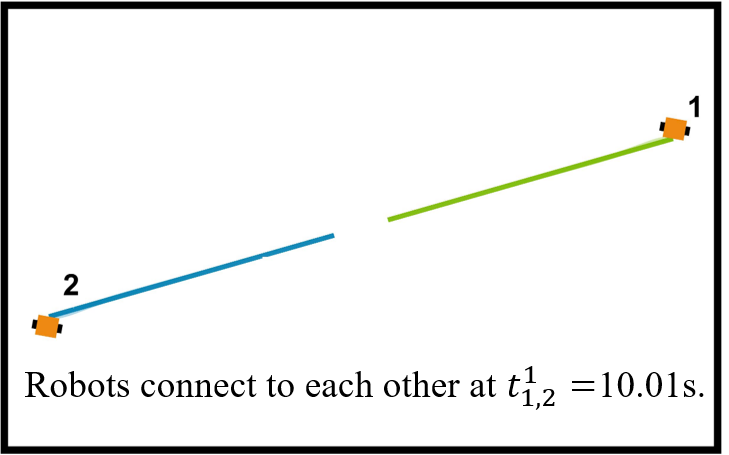
We compare Adaptive PT-CBF against FT-CBF and PT-CBF under the same temporal triggering schedule. Adaptive PT-CBF reconnects earlier without requiring a manually tuned prescribed time, while FT-CBF slows near the communication boundary and PT-CBF is highly sensitive to the chosen value of Tp.
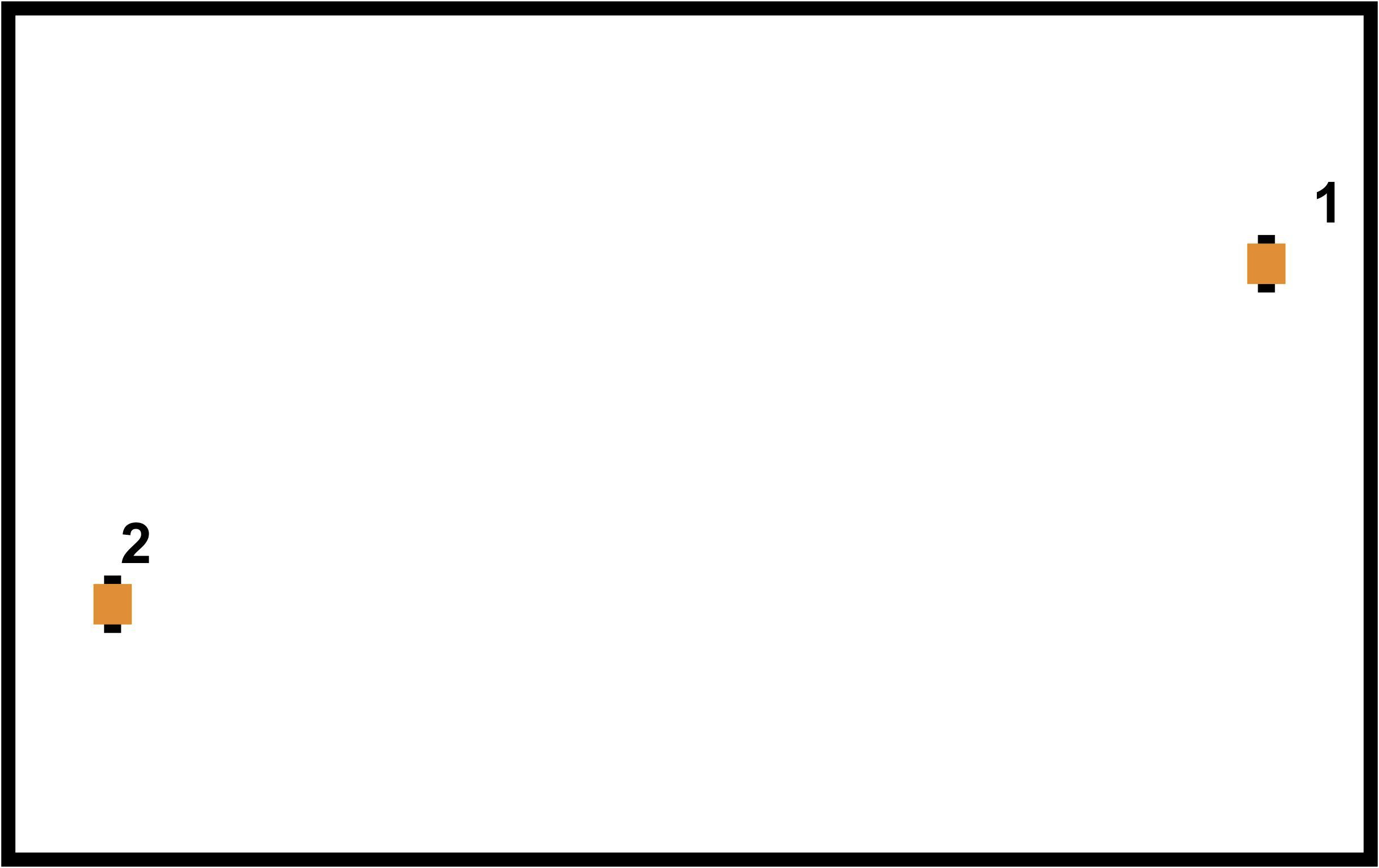
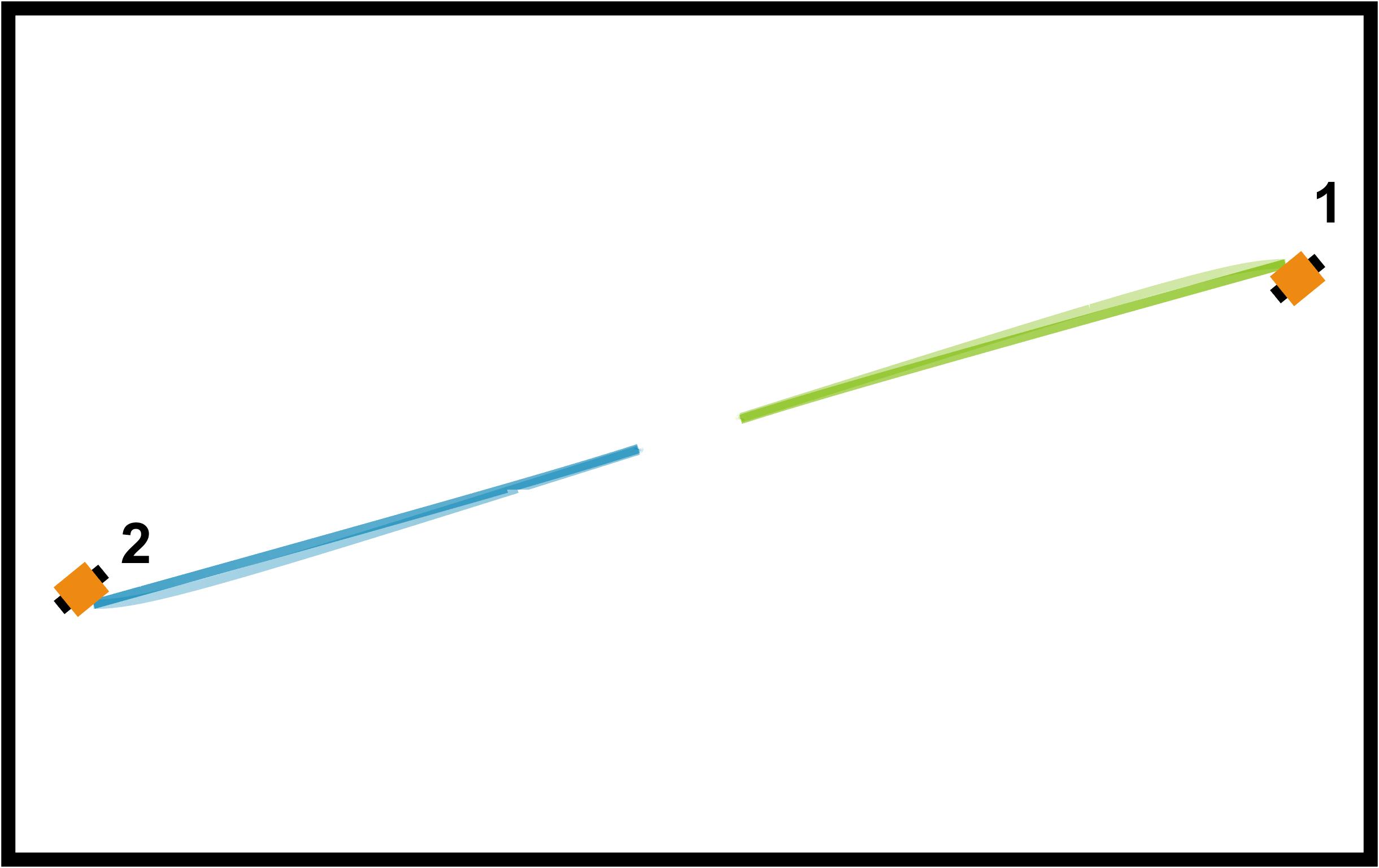
Two-robot snapshot at t equals 0 seconds under Adaptive PT-CBF before reconnection begins.

(a) Adaptive PT-CBF, t = 0s

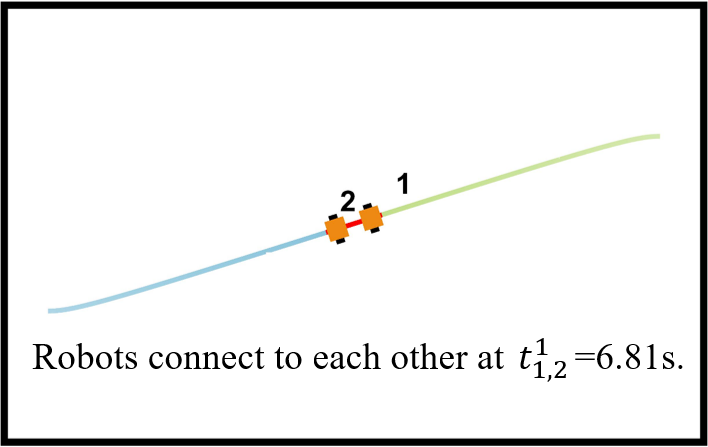
Two-robot snapshot at t equals 6.81 seconds under Adaptive PT-CBF as the robots reconnect.

(b) Adaptive PT-CBF, t = 6.81s

Two-robot snapshot at t equals 15 seconds under Adaptive PT-CBF after reconnection has been achieved.

(c) Adaptive PT-CBF, t = 15s

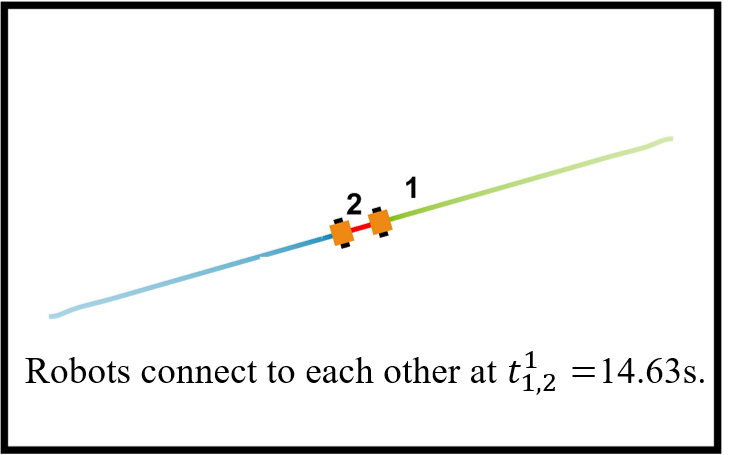
Two-robot snapshot at t equals 15 seconds under FT-CBF showing slower convergence.

(d) FT-CBF, t = 15s

Two-robot snapshot at t equals 15 seconds under PT-CBF with prescribed time 0.5 seconds, showing abrupt behavior.

(e) PT-CBF (Tp = 0.5s), t = 15s

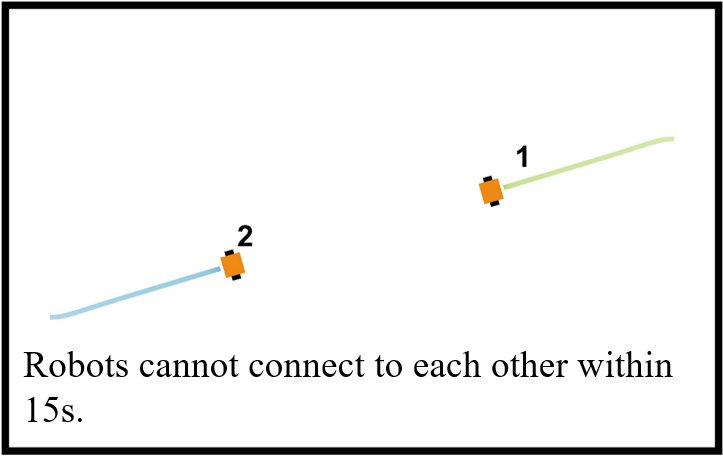
Two-robot snapshot at t equals 15 seconds under PT-CBF with prescribed time 15 seconds, showing delayed reconnection.

(f) PT-CBF (Tp = 15s), t = 15s

Snapshots comparing reconnection performance for Adaptive PT-CBF, FT-CBF, and PT-CBF.

Adaptive PT-CBF reconnects the robots by 6.81 seconds and maintains smooth motion through the remainder of the run. FT-CBF remains conservative near the boundary, while fixed PT-CBF settings can be either too aggressive to be infeasible or too slow to react.

Plot comparing spatio-temporal edge weights over time for Adaptive PT-CBF, FT-CBF, and PT-CBF.

(a) Spatio-Temporal weight


Plot of communication-barrier values R sub c squared minus D sub i comma j squared for three methods.

(b) Rc2 - Di,j2


Plot of inter-robot distance over time relative to the communication threshold.

(c) Inter-robot distance


Plot of average robot speed over time for Adaptive PT-CBF, FT-CBF, and PT-CBF.

(d) Average speed

Comparison of the reconnection process under Adaptive PT-CBF, FT-CBF, and PT-CBF. The plots show the spatio-temporal weight, communication-barrier value, inter-robot distance, and average speed.

All methods share the same trigger-weight schedule for a fair comparison, but Adaptive PT-CBF reaches the communication boundary earlier.

Multi-Robot Case

In CoppeliaSim, five Khepera robots patrol separate regions while Robot 1 must reconnect with Robots 2--5 at least once within each 30-second window. The videos below highlight the behavioral differences among our method, MCCST, and the original task. Here, MCCST is a persistent-connectivity baseline: it enforces persistent global connectivity at every instant, unlike our method, which allows temporary disconnection within each reconnection window.

Video comparisons for the multi-robot patrol task. The top row shows the physical-platform videos and the bottom row shows the corresponding simulation videos.

(a) Original Task

(b) Our Adaptive PT-CBF

(c) MCCST (Persistent Connectivity)

More Research

Explore more papers from our lab through the following research pages.

Time-Aggregated Connectivity Maintenance for Multi-Robot Networks

Hao Liu, Yupeng Yang, Yanze Zhang, Yiwei Lyu, and Wenhao Luo

Robotics: Science and Systems (RSS), 2026

Integrating Online Learning and Connectivity Maintenance for Communication-Aware Multi-Robot Coordination

Yupeng Yang, Yiwei Lyu, Yanze Zhang, Ian Gao, and Wenhao Luo

IEEE/RSJ International Conference on Intelligent Robots and Systems (IROS), 2024

Minimally Constrained Multi-Robot Coordination with Line-of-sight Connectivity Maintenance

Yupeng Yang, Yiwei Lyu, and Wenhao Luo

IEEE International Conference on Robotics and Automation (ICRA), 2023

Decentralized Multi-Robot Line-of-Sight Connectivity Maintenance under Uncertainty

Yupeng Yang, Yiwei Lyu, Yanze Zhang, Sha Yi and Wenhao Luo

Robotics: Science and Systems (RSS), 2024

BibTeX

@inproceedings{liu2026spatiotemporal,
  title     = {Spatio-Temporal Reconnection for Multi-Robot Networks using Adaptive Prescribed-Time CBFs},
  author    = {Hao Liu and Yupeng Yang and Yanze Zhang and Wenhao Luo},
  booktitle = {Proceedings of the 23rd IFAC World Congress},
  year      = {2026}
}